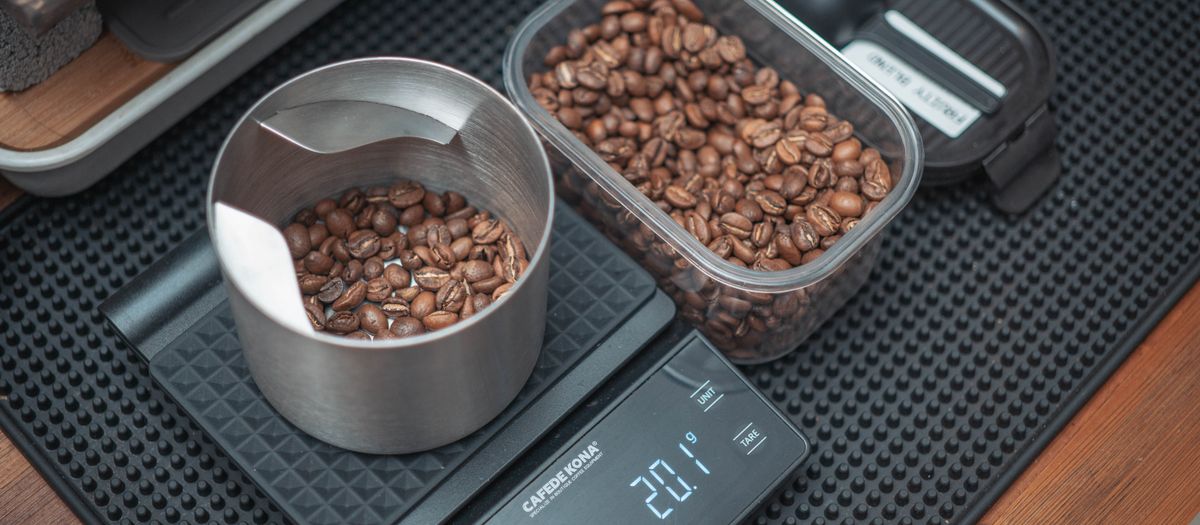
Dialing in is the part that scares people off, and I get it. You’ve got grind, dose, yield, time and temperature all moving at once, and the internet throws a hundred variables at you. When I started I’d change three things between shots and then have no idea what fixed it or broke it. The trick that finally made it click is almost boringly simple: change one thing at a time.
Here’s the routine I actually use when I open a new bag.
Lock down dose and ratio first
Pick a dose and don’t touch it. I weigh a fixed amount of beans into the basket — start near what the basket is built for, so 18 grams for an 18-gram basket. Then pick a ratio. For most beans, a 1:2 ratio is a sane starting point: 18 grams of coffee in, about 36 grams of espresso out. That’s it. Dose and ratio are now fixed anchors. (If you want the yield maths done for you, the dial-in calculator turns your dose and ratio into a target yield and a time window.)
Pull to weight, on a scale, timed
Put your cup on a scale, zero it, and pull until you hit your target yield by weight — not by eye, not by the lines on the cup. Time it from the moment the pump starts. Now you have two numbers: the weight (which you controlled) and the time it took to get there.
Taste, then read what it’s telling you
Sip it. Espresso talks to you if you listen:
- Sour, thin, watery, and it poured fast? Under-extracted. The water rushed through and didn’t pull enough out. Grind finer.
- Bitter, harsh, dry, and it poured slow and stuttery? Over-extracted. The water dragged too long and pulled too much. Grind coarser.
That’s the whole compass. Sour points one way, bitter points the other.
Change grind only — then pull again
This is the discipline that saves your sanity. Adjust the grind one step, keep the dose and ratio exactly where they were, and pull again. Don’t also change the dose. Don’t also change the basket. One variable, one shot, one piece of information. A few cycles of this and you’ll land on a grind setting where the shot hits your target yield in about 25 to 30 seconds and tastes balanced — sweet, round, not sour, not bitter.
A couple of honest notes
You’ll waste a few shots dialling in a new bag. That’s normal, not failure. Fresh beans also keep moving for a few days after roasting as they degas, so don’t panic if a setting that was perfect yesterday needs a nudge today.
And remember the thing that underpins all of it: none of this works if your grinder can’t grind fine and even in the first place. The routine is how you find the setting; the grinder is what makes a setting possible.
When you’re ready to make it concrete, run your numbers through the dial-in calculator — it gives you the target yield, a time window to aim for, and which way to move the grind when it’s sour or bitter.
This is general home-barista technique from my own counter, not a measured test of any product. Dial in to your own beans, grinder and taste.